UART Tip #61: “Oil Pastels: A Seamless Transition” by Katherine Martínez
Let’s take a dive into the vibrant world of oil pastels, where a spectrum of colors awaits! Just like their counterparts in other mediums, there are numerous brands that are crafted to stand the test of time with proper framing and care.
Let’s take a dive into the vibrant world of oil pastels, where a spectrum of colors awaits! Just like their counterparts in other mediums, there are numerous brands that are crafted to stand the test of time with proper framing and care. Just as I use the line of UART surfaces for my soft pastel work, these surfaces are also perfect for oil pastels. In this article, I’ll guide you through four of the many similarities between oil pastels and their soft pastel counterparts, showcasing how seamlessly you can incorporate them into your creative toolkit.
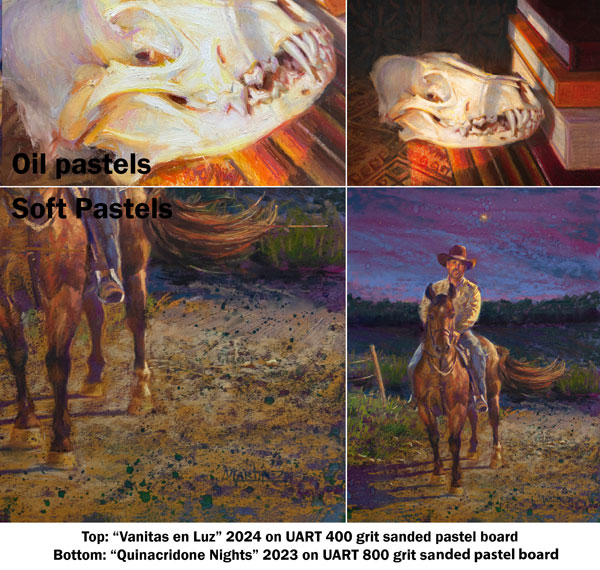
First, both soft pastels and oil pastels give us access to a world of diverse textures! For soft pastels, a calculated splash of isopropyl alcohol can magically reveal underlying stains or washes. In the case of “Quinacridone Nights,” I’d used a special ink with duo-chrome properties that sprung forward when it came in contact with the alcohol and took on different tonalities (see the shift in colors that took place in the horse’s shadow). For oil pastels, we can achieve similar textures by splattering/brushing our paintings with Gamsol and can go even further by stacking the creamiest colors on top in the lit areas of the painting so they can form an impasto-like surface which further emphasizes the details and visual texture, as seen in “Vanitas en Luz” (Vanitas in Light).
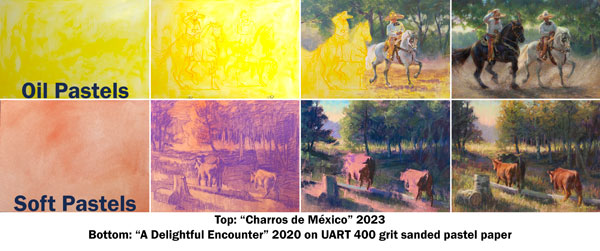
Next, in both “Charros de México” and “A Delightful Encounter,” I applied a base layer of pigment and diluted it with a solvent in order to achieve a base stain that “kills” the white of the paper. While this is not always necessary, especially when using toned UART sanded surfaces (either sand or dark), it can be a useful tool to build tonalities or other effects in our work. Just as these beautiful washes can be achieved with soft pastels by using isopropyl alcohol to dilute and spread the base layer of pigment, the same techniques can be used with oil pastels by substituting alcohol for Gamsol. In both cases I tend to use a hardier bristol brush to spread the color.
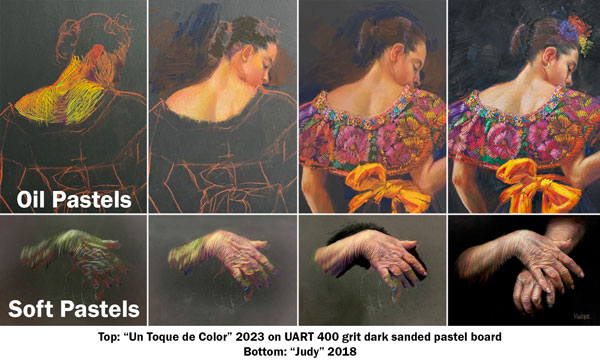
Additionally, when working with complex subjects like skin tones, which contain multiple subtle chroma and temperature shifts, for both media I can start with a complimentary green base layer, traditionally known as Verdaille or Verdaccio. From there, we can weave layer upon layer of complimentary colors until they neutralize each other and reveal the natural “skin” tone we are looking for. Since both media come in stick form, I simply layer striations that follow the subject’s turning form until the layers blend sufficiently to create a smooth, skin-like surface.
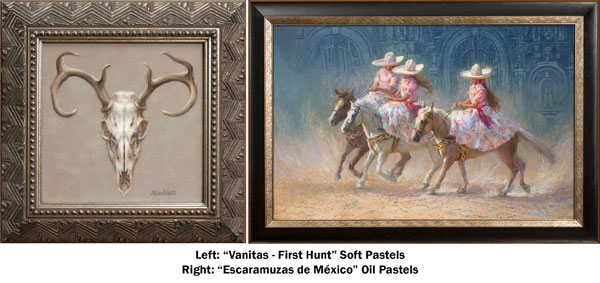
Lastly, the process for framing our oil and soft pastels is identical. The safest way to store any oil or soft pastel painting is framed under glass. For those who want to protect their paintings further or plan to sell their work to appreciative clients, I recommend using a high quality, UV-protected glass, preferably an anti-reflective museum glass. Additionally, it is important to leave a small amount of space between the artwork and the glass, either by using spacers or a mat, as this lessens the possibility of condensation forming on the inside of your glass in warmer environments and ruining your hard work. When carefully handled and framed, both oil and soft pastel paintings can easily survive the test of time and remain just as beautiful as the day they were made.
Both oil and soft pastels are incredibly challenging, satisfying, and gorgeous media. While they share many similarities, both offer their own special twists that allow for unique and varied painting experiences. So, are you ready to add a new splash of color and texture to your artwork? Take oil pastels for a spin! If you’d like to see more examples visit my website at www.katherinemartinezfineart.com and follow me on Instagram @kmartinez.fineart to see more progress images and videos.
Need More Information?
Have questions about our products? Visit our FAQ page for answers to common inquiries, tips, and detailed product information to help you make the best choice for your artistic needs.
Check FAQ